
Clay County Parole vs Probation
Probation, supervised release, and parole all permit a person to live outside a secure facility while remaining subject to legal controls. They do not arise the same way. Clay County probation commonly follows a district-court disposition without a commitment to state prison, though a judge may make some local jail time a condition. Supervised release follows the imprisonment portion of an executed Minnesota Department of Corrections sentence. Minnesota uses that determinate structure for most modern prison sentences, so “parole” is often used loosely when the record actually says supervised release.
The controlling record matters. A court register can show probation, later violations, revocation, or discharge. The MNDOC Public Viewer can show a person released from prison but still under MNDOC jurisdiction. A limited set of people may have a hearing before the Minnesota Supervised Release Board, but an ordinary approaching prison-release date does not create a board case.
| Supervision type | How it begins | Best verification record | How it ends |
|---|---|---|---|
| Probation | Clay County court order after disposition | Court register, order, and probation office | Court discharge, expiration, or other order |
| Supervised release | Transition from the prison portion of an executed MNDOC sentence | MNDOC detail record and sentencing order | Sentence expiration or DOC discharge |
| Board parole or release | Board action for a limited eligible population | Board agenda, approved minutes, and MNDOC record | Final discharge or other authorized end |
- Discharge
- The formal end of supervision or sentence authority, not merely release from a building.
- Revocation
- An official process that may cancel community status after an alleged violation.
- Absconded
- An agency status alleging that a supervised person stopped reporting or cannot be located.
- Detainer
- A request or legal hold that can affect movement or release to another authority.
Verify Clay County Post-Release Supervision
Start with the authority that imposed the sentence. Clay County/Minnesota Department of Corrections Probation Services handles the local arrangement described by the county. MNDOC also supervises people who leave state prison and probation cases in counties where the state provides that service. A county jail release, by itself, does not prove probation. Likewise, an MNDOC “Under Supervision” status concerns state corrections jurisdiction and should not be restated as county probation unless the underlying record says that.
- Search the Clay County criminal case in Minnesota Court Records Online. Read the sentencing entry and later probation, warrant, revocation, and discharge events in date order.
- If the person was committed to the Commissioner of Corrections, search the MNDOC viewer by full name or complete six-digit offender ID. Open the detail record and record the exact status.
- Compare the supervising agency, agent, sentence date, expiration date, offense, and court file when those fields appear. Do not treat a result-list snippet as the full record.
- Contact the supervising office for information it may lawfully confirm. Use the court or issuing agency for a warrant because a status label alone is not a warrant record.
- Recheck the court and MNDOC record after the expected end date. A release from custody and a final discharge are separate events.
For the county-jail release record and the full custody trail, use the Clay County released inmate search. That record can establish when county custody ended, while the court and MNDOC sources explain what authority followed.
Clay County Probation Services
The local service is identified as Clay County/Minnesota Department of Corrections Probation Services. Public information may be limited, so a call should ask which office holds the supervision record and what public channel applies. Do not ask staff to infer status from a name alone. A date of birth, court file number, and MNDOC ID can help separate people with similar names while reducing the risk of using the wrong case.
Clay County / MNDOC Probation Services
Clay County probation services
State supervision information: MNDOC Community Supervision
Public status records: MNDOC Public Viewer
The Public Viewer can return adults who remain under MNDOC jurisdiction in prison or in the community. It may show “Under Supervision as of” a date, the supervising agency, agent, sentence date, expiration date, offense, and court file. A county-only booking never enters that viewer merely because Clay County held the person. After final DOC discharge, a person may no longer be returned, making the court file and a records request the better historical route.
The official Clay County probation services page shows the local agency connection captured in the research.
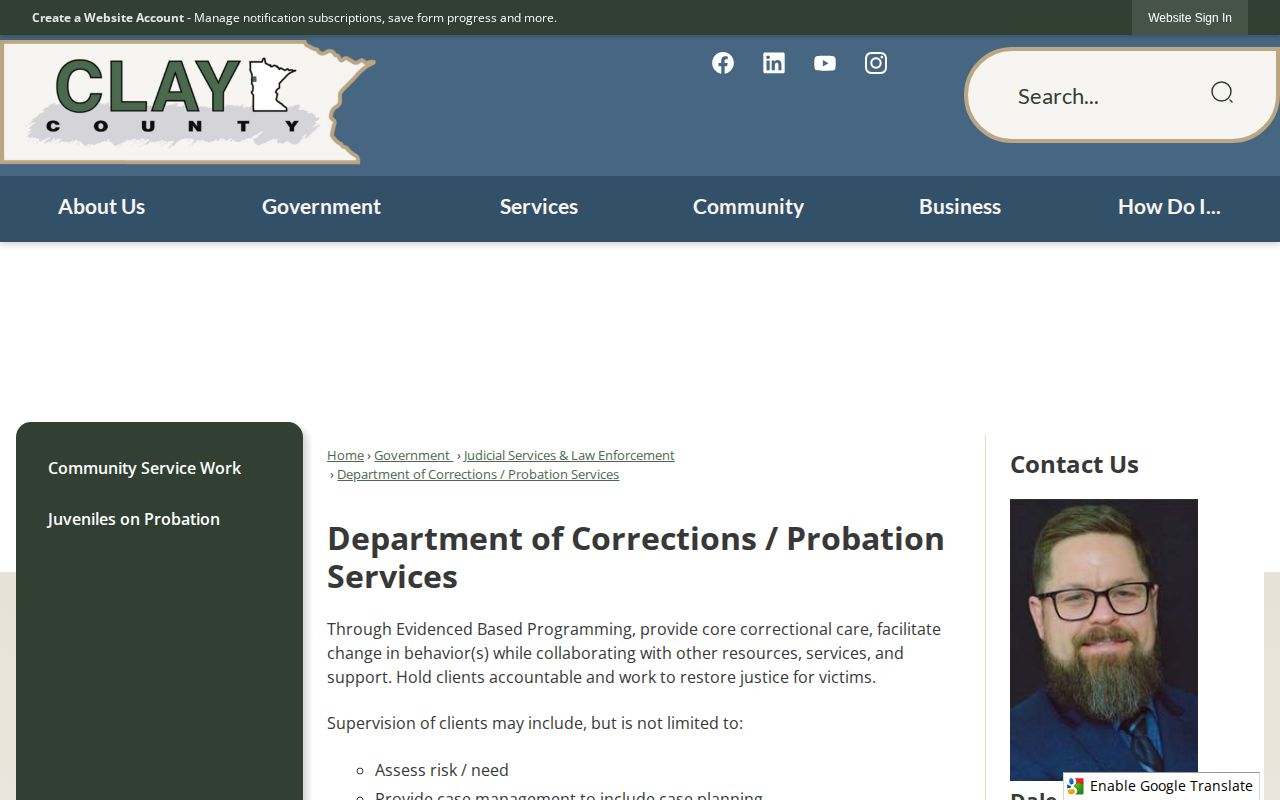
This source helps identify the right supervision office, but the person’s court and MNDOC records still control the actual status.
Clay County Supervision Violations
Conditions vary with the judgment, release plan, and supervising authority. They may require reporting, compliance with court orders, participation in approved services, or limits set in the individual record. A general agency page cannot establish one person’s terms. Use the sentencing order, written release conditions, and later court entries. If an alleged breach leads to a revocation case, the docket may show the filed violation, warrant, hearing, decision, and amended sentence.
An “absconded” or fugitive indicator is an allegation about compliance or location. It is not a new conviction. A warrant may follow, but warrant status should be checked with the issuing court or law-enforcement agency. No complete Clay County public absconder list was found. Minnesota VINE also is not a supervision tracker. It reports county-jail custody events and can help if a new booking occurs, but it does not replace the court or supervising agency.
Keep the labels exact. “Wanted,” “absconded,” “violation filed,” and “revoked” describe different stages. Dates matter too. An old warrant entry may later be cleared, and a past revocation may be followed by a new supervision period. Read the full sequence before drawing a conclusion.
Note: Confirm a claimed warrant with the issuing authority because a supervision status or old docket entry may not reflect the current legal state.
Clay County Parole Hearing Limits
Most current Minnesota prison cases do not receive a routine parole hearing. The Minnesota Supervised Release Board, operating since July 1, 2024, has a limited statutory population. Under Minnesota Statutes section 244.049, that jurisdiction includes certain parole or supervised-release eligible life sentences, pre-May 1, 1980 indeterminate sentences, and defined people eligible for early supervised release for offenses committed while under age 18.
The Board schedule and results hub publishes meeting details, agendas, recordings, and approved minutes. Materials remain there for about 90 days. No separate person-name decisions search was verified. Approved minutes serve as the published result. A listed meeting is not a decision, and a grant may take effect later or place the person into a consecutive sentence instead of the community.
Possible outcomes include a grant subject to release planning, denial, later review, a projected release date, or a final-discharge determination within the Board’s authority. Eligibility depends on the judgment and the applicable part of section 244.05. It should not be guessed from sentence length. For an ordinary Clay County determinate sentence, the higher-value records are the MNDOC viewer, sentencing order, court register, and community-supervision contact.
Clay County Release Advance Planning
Clay County’s adult jail operates a named Release Advance Planning program, often shortened to RAP. The county says staff work with county and community entities and the participant to develop a plan for reintegration. That makes RAP a local reentry contact point before release. It is not proof that a person was accepted, finished a program, received a specific service, or will succeed on supervision.
A plan may help coordinate practical needs with the duties imposed by a court or supervision officer. Those duties still come from the person’s order and agency. Family members reconnecting with someone should use the approved plan and current office instructions, especially when living arrangements, transport, treatment, or reporting duties affect the first days outside custody.
The county’s Correctional Facility Programs page describes this local reentry work. RAP belongs to the county jail context, while MNDOC handles prison-release planning and statewide community supervision. Keeping those systems separate prevents a well-meant call from going to the wrong custodian.
Clay County Post-Release Property
Supervision questions often arise at the same time as practical release tasks. Clay County publishes a firm rule for property left at the jail: it is held for 90 days after release and then destroyed if unclaimed. A released person should contact the Clay County Correctional Facility promptly about the pickup process, identity requirements, and whether another person may collect items.
This deadline does not extend probation or supervised release. It is an operational jail rule. The county inmate contact, funds, and property page also helps identify items that may have remained in storage. Keep the property question separate from the court or MNDOC status inquiry so each office can answer the matter it controls.
A transfer can complicate the trail. If Clay County sent the person to MNDOC or another custodian, ask which property moved with the person and which property stayed at the county jail. Obtain the answer early enough to meet the published deadline.
Clay County Supervision Discharge
Leaving custody is not the same as finishing supervision. Probation ends through a court discharge, expiration, or another valid order. MNDOC jurisdiction ends with the applicable sentence expiration or discharge, not merely the day a person leaves prison. A supervised-release record can therefore show the person living in the community while the sentence remains active.
Verify the end through the record that created the authority. For probation, read the Clay County register of actions for a discharge entry or order. For supervised release, compare the MNDOC status and expiration information with the court sentence. For the Board’s limited population, use approved minutes and the later DOC record. If dates conflict, request the official record instead of selecting the most favorable date.
The legacy good-time law at Minnesota Statutes section 244.04 applies only to its qualifying older population. It should not be used as a modern universal release formula.
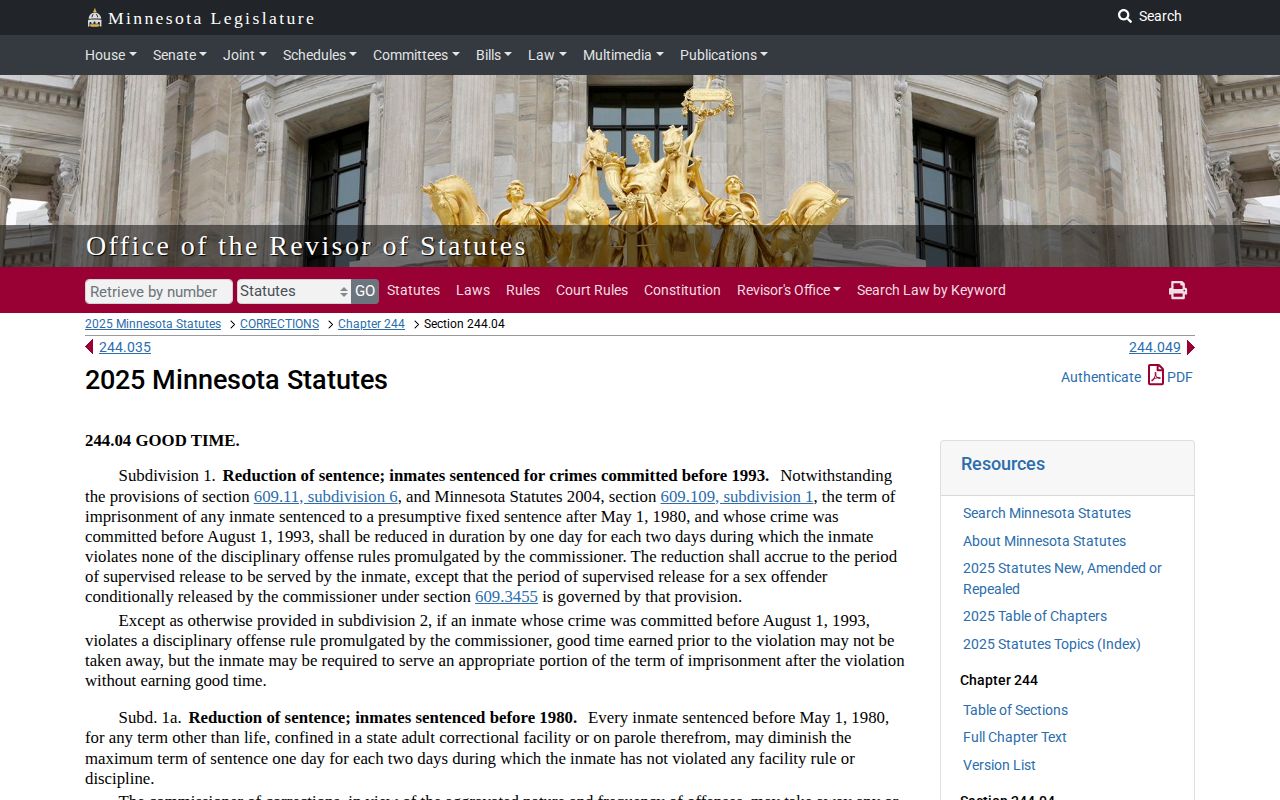
The statute illustrates why offense date and governing law must be checked before interpreting a Clay County supervision or discharge timeline.