
WCRJC Release Information Limits
West Central Regional Juvenile Center is a regional juvenile operation in Moorhead. It is not an adult jail and its residents should not be presented as “released inmates.” Juvenile court records, placement data, treatment information, and transition plans can have access limits based on age, case type, the requester’s authority, and court orders. Clay County publishes no public recent-release feed or adult-style roster for the center.
A person’s absence from an adult county roster says nothing about WCRJC placement. The adult roster belongs to the Clay County Correctional Facility and is built for current adult county custody. It cannot be repurposed to check a youth. A valid inquiry begins by identifying the referring court or agency, the assigned worker, and the requester’s legal relationship to the case.
Confirm a WCRJC Transition
Authorized confirmation is a case-specific process. The correct route depends on whether the youth is in secure detention, a non-secure program, transition services, or another placement. Center staff may need to verify the caller’s identity and authority before discussing any detail. A lawyer or assigned case worker can often identify the court order and next placement without forcing a broad records inquiry.
- Identify the referring court, county, or agency and the youth’s assigned worker.
- Confirm that the requester is a parent, guardian, counsel, case participant, or other authorized person.
- Contact the assigned worker or lawyer for the operative placement or release order.
- Call WCRJC for permitted operational routing, not for a public roster search.
- Use an authorized records process only for data the requester has a right to receive.
The court order may authorize a move, but the center’s actual transition records establish when the move took place. A change from secure to non-secure programming is not always release to the community. Likewise, transition support after departure does not prove that all court supervision has ended.
WCRJC Contact and Records
Clay County lists the center at 729 11th Street North in Moorhead. The published telephone is the appropriate first point for an authorized placement or transition question. Staff may decline details when the caller lacks authority, and that response should be respected. The office hours describe the public contact window, not the complete schedule for youth movements or court-directed action.
West Central Regional Juvenile Center
729 11th Street North
Moorhead, MN 56561
218-299-5150
Monday–Friday,
8:00 a.m.–4:30 p.m.
A records request must be narrowly framed and should identify the youth, the referring authority, the approximate dates, and the requester’s relationship to the case. Do not ask the center to create a public release list. If the center requires proof of authority, follow its secure verification method and do not send sensitive identity papers through an unapproved channel.
Note: The adult Sheriff Records Division route does not erase the separate confidentiality rules that apply to juvenile data.
WCRJC Programs and Population
The official statement of intended use describes secure and non-secure components for a regional referral population. Clay County reports a 55-bed secure facility and a 25-bed non-secure program. The general service population spans youth and, in some extended-jurisdiction matters, young adults. Those figures describe program capacity, not a public count of current residents or releases.
The county source is shown below because it fits this specific facility and explains its intended use. It does not supply a name search or a public transition log.
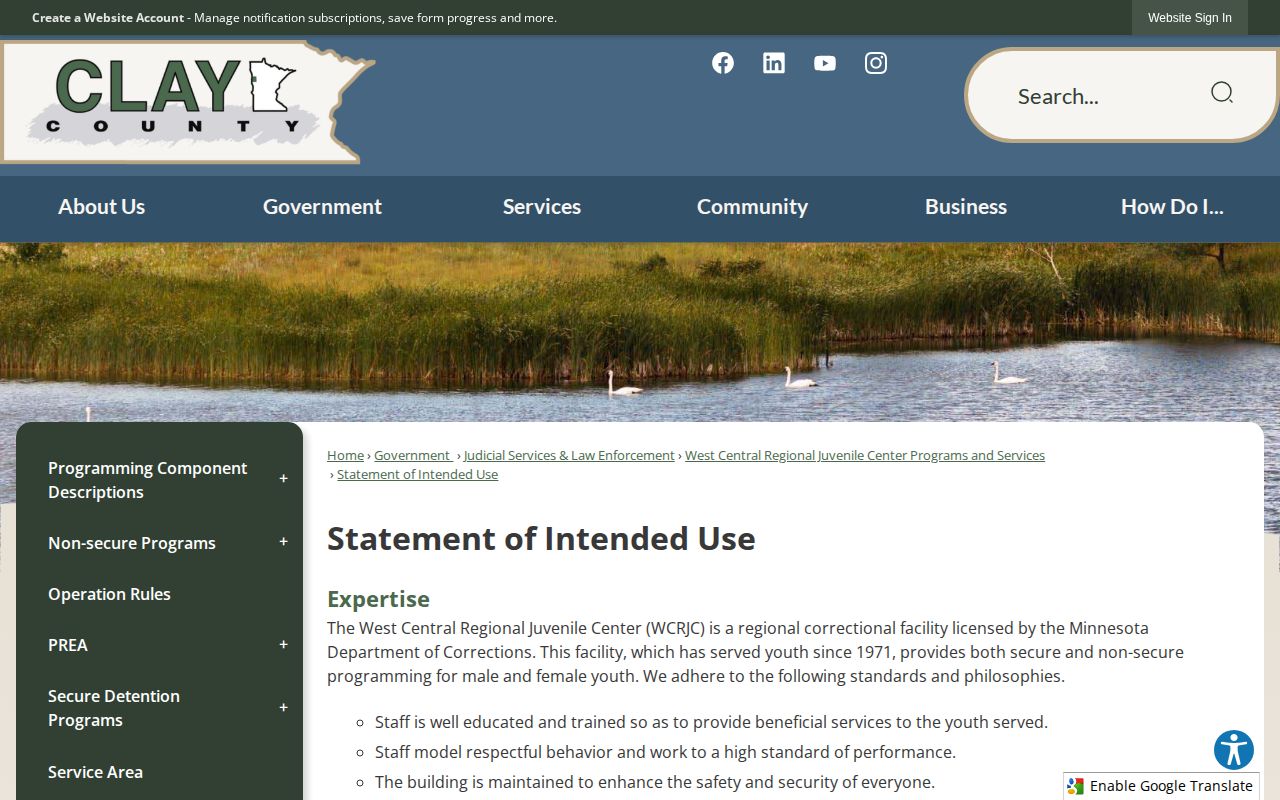
The public description helps distinguish the center from the adult jail while leaving personal juvenile placement facts within authorized channels.
WCRJC Secure and Non-Secure Moves
“Release” can obscure the actual juvenile event. A youth may move from secure detention into a non-secure component, return to a referring county, enter another program, go home under conditions, or continue under court and agency oversight. Each path has a different record and different people authorized to receive it. The center’s regional role also means that physical location in Clay County does not necessarily make Clay County the referring authority.
| Event | Best confirmation route |
|---|---|
| Secure to non-secure move | Center, assigned worker, and operative placement order |
| Return to family or guardian | Authorized family contact, worker, counsel, and court direction |
| Transfer to another placement | Referring agency and receiving program |
| Transition-program follow-up | WCRJC Transition Services staff and assigned case contacts |
| End of court jurisdiction | Referring court and counsel |
None of these events should be inferred from a search engine result. Public web pages describe programs. They do not establish who is enrolled, who left, or why a youth changed placement.
WCRJC Post-Release Transition Services
The WCRJC Transition Services Program is the facility’s most distinctive post-release feature. Clay County states that services normally continue for up to three months after release for eligible youth and may continue longer based on need. This is continuing support, not a public locator and not a promise that every youth qualifies.
Transition contact can help link the placement period with a return to school, family, community services, or another case plan. The exact plan depends on the youth, referring authority, court direction, and program eligibility. A continuing contact with WCRJC also does not mean the youth remains confined. It may reflect planned follow-up after the residential phase ends.
The official program page is shown below. It supports the distinction between the center’s program work and an adult custody search.
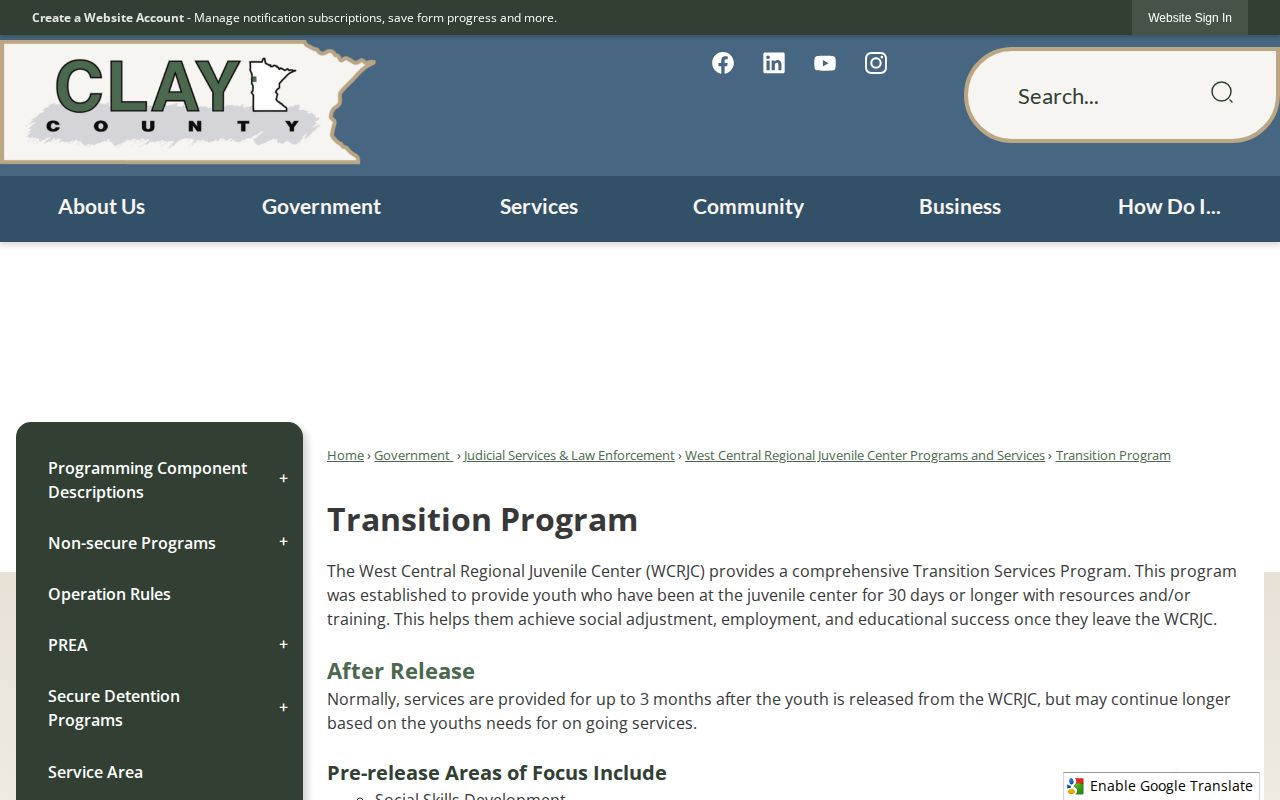
The county material directs authorized people toward transition planning while preserving the fact that individual participation is not public roster data.
WCRJC Court and Agency Roles
Jurisdiction follows the case and referring authority. The center operates the placement, but the court or agency may control the legal basis for detention, transfer, community return, and continuing conditions. Counsel interprets the order. The assigned worker coordinates the case plan. Center staff record the actual movement and provide information within the requester’s authority.
These records answer different questions. A court order can authorize a transition. The center’s operational record can establish when it occurred. A case plan can describe services and conditions. A later court entry can show whether jurisdiction or supervision ended. Combining them is more accurate than asking one office to speak for the whole case.
- Placement
- The authorized setting where the youth is assigned to live or receive services.
- Transition
- A planned move between levels of care, programs, or community settings.
- Referring authority
- The court, county, or agency responsible for placing the youth.
- Discharge
- An end to a program or legal status whose exact meaning depends on the governing record.
WCRJC Versus Adult Releases
The adult Clay County Correctional Facility release route uses a current adult roster, Sheriff records, VINE, and criminal court files. WCRJC does not use that public architecture. An adult booking record can contain fields available under Minnesota data law, while juvenile placement and court records may remain restricted even when the youth has left the building.
This difference protects both accuracy and privacy. It prevents a confidential transition from being turned into a public claim. It also directs an authorized person to sources that can actually help: counsel, the referring court, the assigned worker, and WCRJC. If a search concerns an adult in county custody rather than a youth placement, the main Clay County release search supplies that separate path.
Note: A youth who reaches adulthood during an extended-jurisdiction matter does not automatically become part of the adult jail roster.
WCRJC Record Date Labels
Regional placement changes who holds the most useful record. WCRJC may document admission, movement, and program work, while a referring county keeps its own file and the court keeps legal orders. An authorized family member may need to contact more than one office. Each request should name the record sought and establish the requester’s authority.
An order date, secure-placement end date, start of non-secure services, physical return date, and final case discharge can all differ. Record the label used by the source. “Transition began” does not mean court control ended, and “released from secure care” does not mean all WCRJC services stopped.
A partial response may reflect juvenile confidentiality, third-party privacy, treatment-data limits, or a court order. Ask the custodian about the proper review process. Do not fill gaps with social media, an adult roster, or an unrelated case. A lack of public detail is an access boundary, not proof of a hidden release.