
Clay County Projected vs Actual Release
A projected or scheduled date is forward-looking. It reflects the calculation in force when the record was prepared. The actual release date records what happened after staff processed the sentence, reviewed court orders and holds, and completed any transfer. An expiration or discharge date addresses the end of the sentence. A supervised-release date addresses movement from prison confinement into the community under correctional authority. Those dates may all differ.
Pretrial custody has another logic. A person awaiting disposition may have bail set, but payment does not establish an exit time. Clay County says payment begins a multi-step release process. A judge may change conditions, another authority may lodge a hold, or the case may proceed without a set departure date. Do not manufacture a projected date from a hearing date, bail amount, or absence from the roster.
- Anticipated Release Date
- The exact forward-looking label observed in the MNDOC Public Viewer.
- Supervised release
- The community portion of an executed state sentence, still under correctional authority.
- Expiration
- The scheduled end of the sentence, subject to the governing record and later orders.
- Discharge
- The formal end of correctional or supervision authority.
Find Clay County Projected Release Dates
Begin with custody type. Clay County jail sentences and MNDOC commitments use different calculations and record systems. The county roster is current-custody oriented and has no projected-release field or past-release archive. The MNDOC viewer covers adults committed to the Commissioner who remain under state jurisdiction, whether incarcerated or in the community on supervision. A county-only sentence does not enter that system merely because the person served time at the Clay County Correctional Facility.
- Read the Clay County court register and sentencing order. Identify pretrial status, local jail sentence, or commitment to the Commissioner of Corrections.
- For a state commitment, open the MNDOC Public Viewer. Search by name or the complete six-digit offender ID and open the detail record.
- Record the exact status, facility or supervising location, sentence lines, Anticipated Release Date, Expiration Date, and any other release-related label.
- For a local jail sentence, ask Clay County jail staff for the calculated date and obtain the court order, jail credit, and local release record.
- Check for concurrent or consecutive terms, conditional-release periods, warrants, detainers, and amended orders that can change the practical result.
- After the expected date, recheck status and obtain the actual release timestamp and destination.
The Minnesota corrections chapter is the successful overview capture matched to the state sentencing framework.
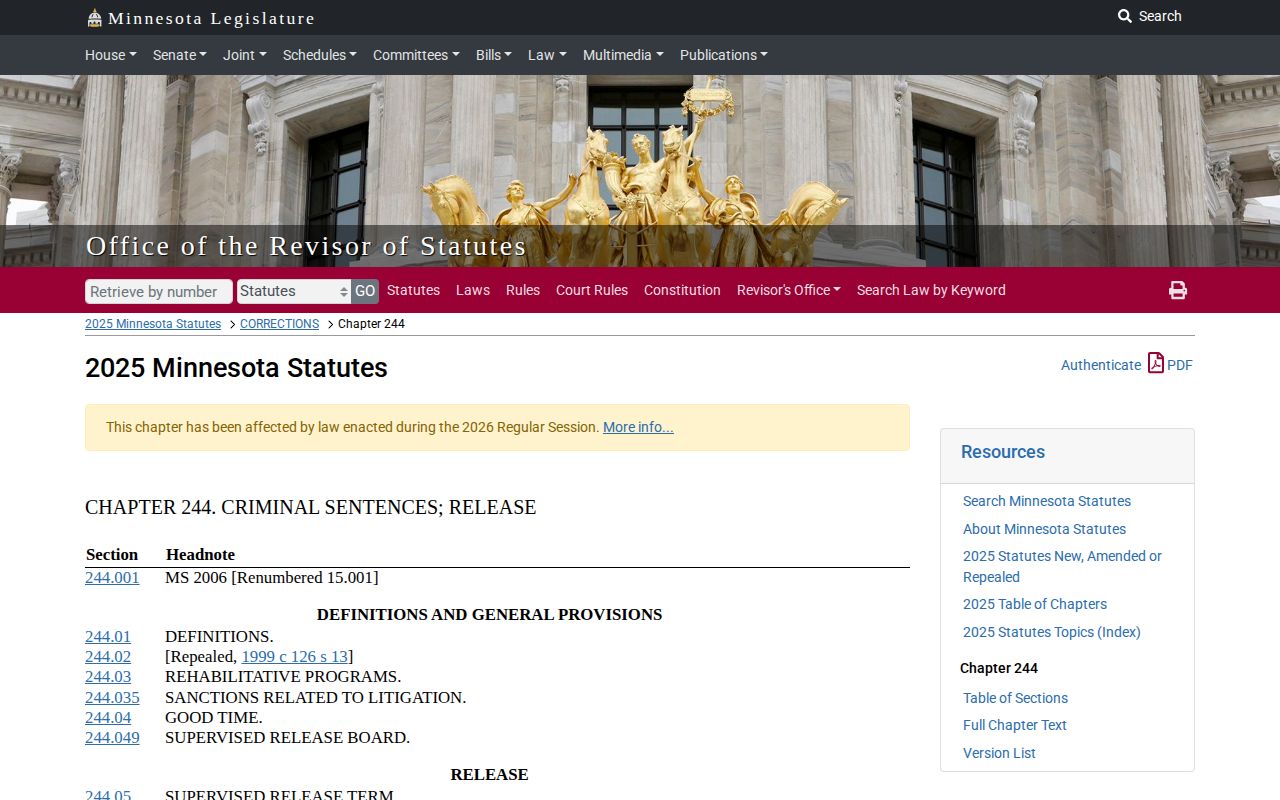
Chapter 244 supplies the legal framework, while the person’s judgment and live MNDOC calculation supply the usable date.
For a full county release record and search trail, the Clay County released inmates lookup distinguishes the jail roster, court file, state viewer, VINE, and records-request paths.
Clay County MNDOC Date Fields
The MNDOC viewer should be read from the detail page, not a result-list snippet. Search accepts first and/or last name, including prefix and name-history matching, or a complete six-digit MNDOC Offender ID. Results can identify name, birth date, aliases, ID, and current status. Newly sentenced adults may take several business days to appear, and a person after final DOC discharge may no longer return.
A Clay-court-linked public example reviewed in the research displays the exact label “Anticipated Release Date,” along with Expiration Date, current facility and status, sentence date, caseworker, offense, and court file. Another public example shows “Under Supervision as of” a date, supervising agency, agent, sentence date, expiration date, offense, and court file. Those examples establish field vocabulary; they are not people to feature.
| MNDOC field | What it answers |
|---|---|
| Current status | Whether the record reports confinement or community supervision under MNDOC |
| Anticipated Release Date | Forward-looking prison release calculation displayed on the detail record |
| Under Supervision as of | Date the released person’s supervision status is reported from |
| Expiration Date | Sentence-end field, not necessarily the prison exit date |
| Facility or supervising agency | Current prison placement or community-supervision authority |
| Court file and sentence | Links the DOC calculation to the underlying Clay County judgment |
If no result appears, check spelling, older coverage, county-only custody, juvenile status, federal custody, and whether MNDOC ever received the person. Use the court sentence and MNDOC records staff for a historical or missing state record.
Clay County Executed Sentence Division
Minnesota does not use the 85-percent truth-in-sentencing formula common in some other states. Under Minnesota Statutes section 244.101, an executed sentence has imprisonment and supervised-release parts. The traditional statutory division is two-thirds imprisonment and one-third supervised release, subject to chapter 244 and the individual sentence. Reaching supervised release means leaving prison under conditions. It does not mean the sentence has ended.
The executed-sentence statute is paired with a successful project capture.
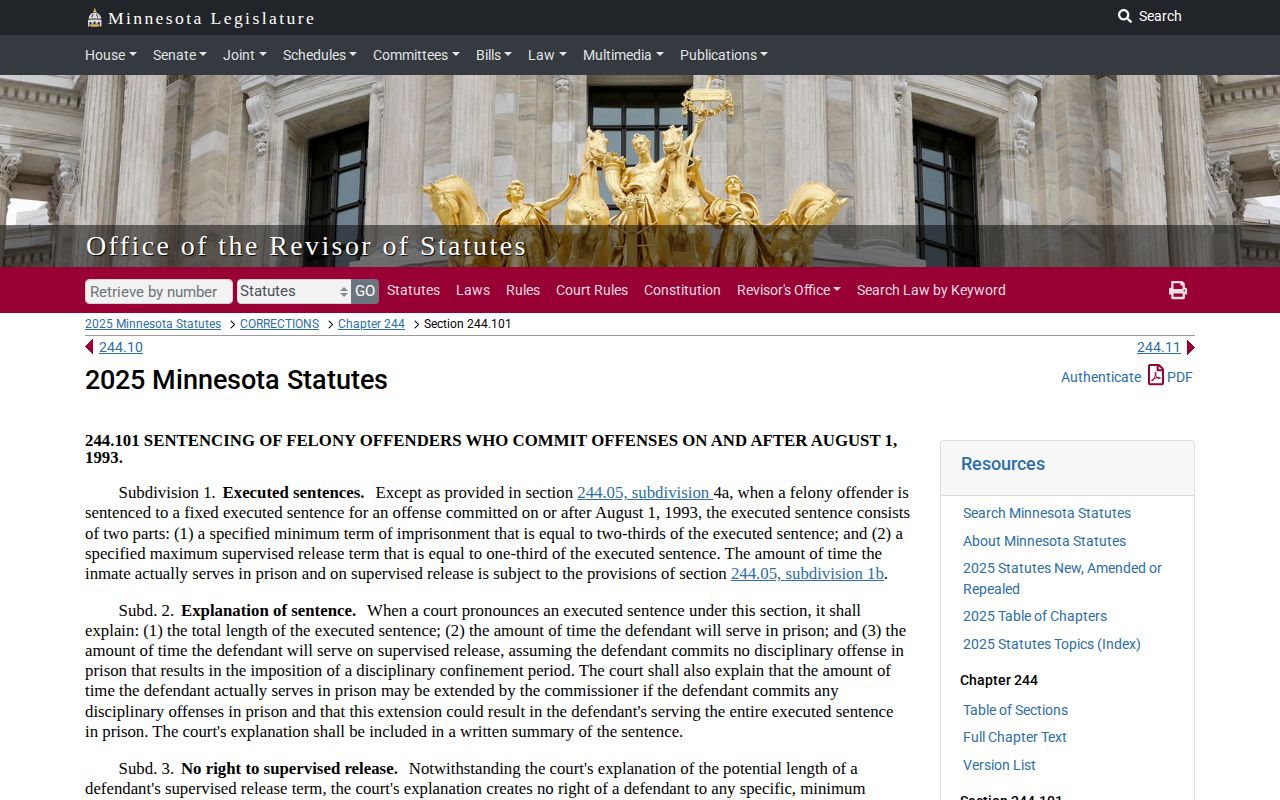
This law explains why a Clay County state-prison record can show both a prison release date and a later expiration date.
Never multiply the pronounced sentence and present the result as the official date. Jail credit, concurrent or consecutive terms, disciplinary confinement, earned-incentive rules, conditional-release terms, revocation, and later court action can change the timeline. Start with the MNDOC field, then compare it with the signed sentencing order.
Clay County Earned Release Credit
Minnesota’s earned-incentive framework requires person-specific review. Under section 244.44, earned incentive release credit may affect the imprisonment portion for an eligible person. The credit is capped at 17 percent of the total executed sentence and cannot reduce imprisonment below half of that sentence. It does not enlarge or replace the supervised-release term.
The earned incentive release credit statute appears in a successful capture from the manifest.
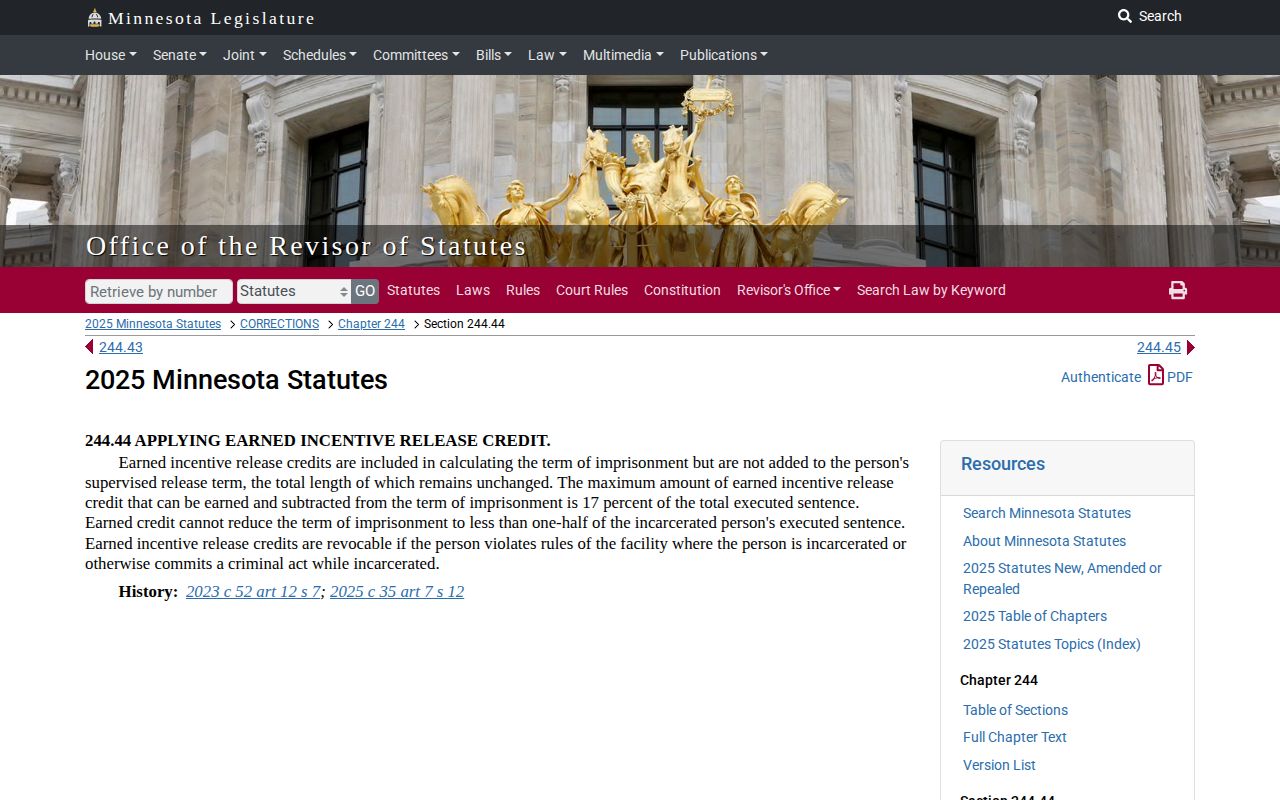
The statute provides the limit, but MNDOC determines eligibility and applies approved goals, completion, and administrative rules to the individual record.
Exclusions matter. Section 244.45 excludes life sentences, pre-May 1980 indeterminate sentences, and people governed by the legacy good-time law or comparable provisions. MNDOC policy 204.064 provides administrative detail. The older section 244.04 rule, for its qualifying pre-August 1, 1993 crime population, provided one day of reduction per two discipline-compliant days toward supervised release. That legacy rule is not a modern universal subtraction.
The earned-credit exclusions also have a page-specific source image.
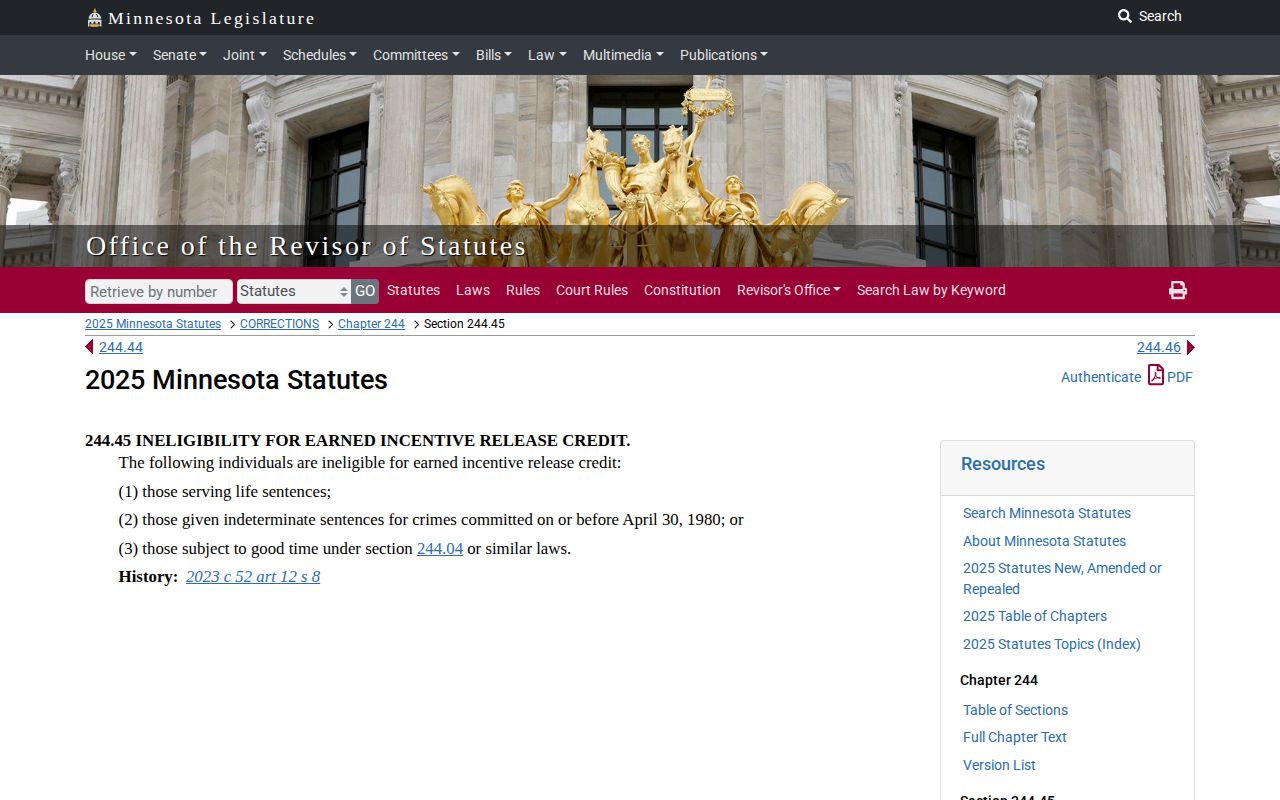
Read eligibility and exclusions together before interpreting any shift in the displayed Clay County state-prison date.
Note: The official MNDOC calculation controls; a private hand calculation cannot account for every sentence, credit, exclusion, or later legal change.
Clay County Weekend Release Rules
Minnesota Statutes section 244.05 contains a weekend and holiday rule. For crimes committed after August 1, 1992, a release date falling on Friday, Saturday, Sunday, or a legal holiday moves to the first later qualifying day. The older population uses the last prior qualifying day. The offense date is therefore essential before applying the rule.
The supervised-release and weekend rule is shown in this matched source capture.
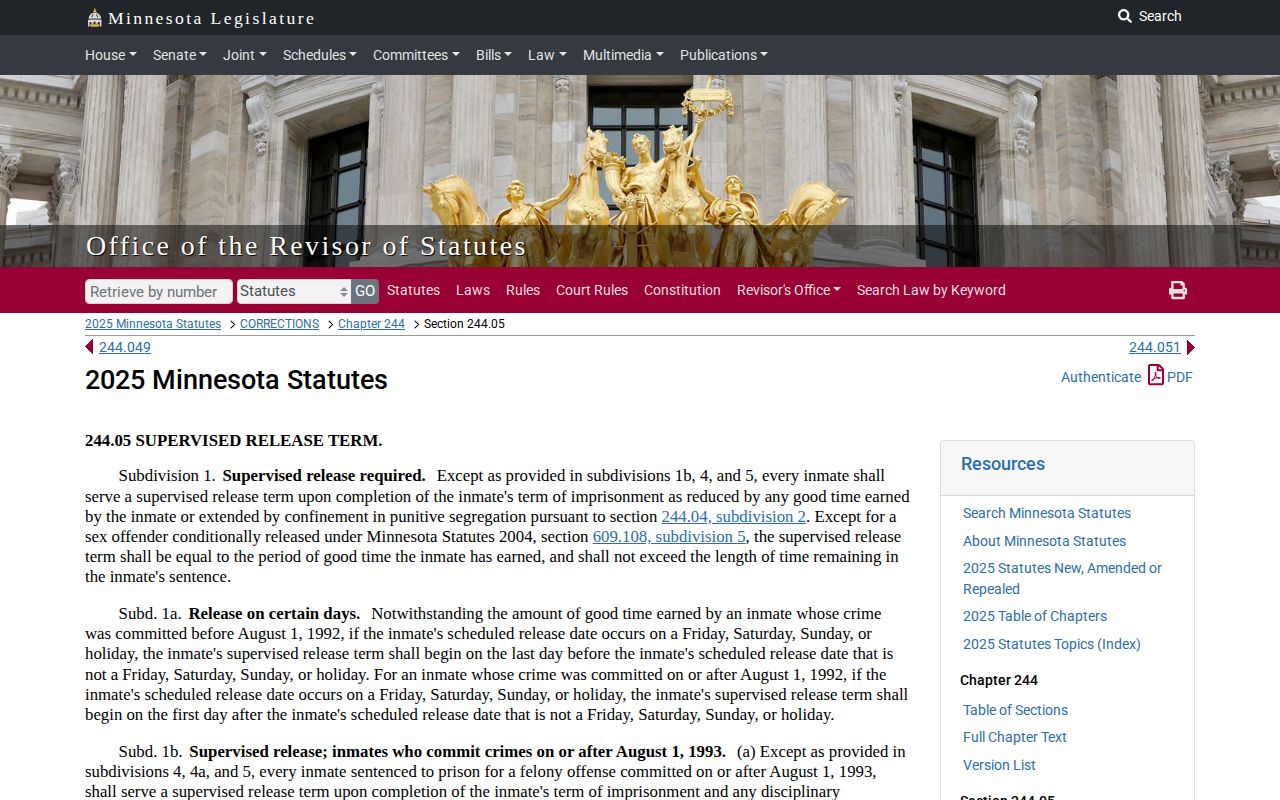
This calendar adjustment concerns the statutory release date. It does not establish the hour of physical departure or defeat another valid hold.
Clay County Jail Release Calculation
A Clay County jail sentence cannot be calculated with the state-prison formula. Start with the court’s pronounced local sentence, custody start, jail credit, and whether terms run concurrently or consecutively. Add any court-authorized work or program release. Then ask the Clay County Correctional Facility for the calculated date and, after departure, the actual timestamp.
Work release is not discharge. Clay County charges a $20 Huber fee for each day an authorized work-release participant is out and a $15 drug-screen charge for program release. Those charges show that a person can leave for approved activity while the jail sentence remains under administration. They are not a fee to obtain release and must not be merged with the separate booking or bail-kiosk charges.
The Clay County reporting and program-release page documents the local structure behind this distinction. The final release still requires the jail record. A day outside for work does not prove sentence completion, and the return schedule does not create the final discharge date.
Why Clay County Release Dates Change
A displayed date can move because the underlying sentence, credit, behavior, or receiving authority changes. Some changes are legal, while others are administrative corrections. Record the old label and retrieval date if tracking a change. Then obtain the later official entry instead of treating the first screenshot as permanent.
| Factor | Possible effect on release | Record to check |
|---|---|---|
| Corrected jail credit | Moves the calculated confinement period | Amended order and DOC or jail calculation |
| Concurrent or consecutive terms | Combines or stacks sentence time differently | Judgment and sentence lines |
| Earned-credit eligibility | May reduce qualifying imprisonment | MNDOC record, policy, and statutory eligibility |
| Disciplinary action | May affect credit or confinement under governing law | DOC calculation and authorized decision |
| Conditional-release term | Adds or changes post-prison authority for defined offenses | Judgment and applicable statute |
| Detainer or warrant | Can cause transfer instead of community release | Issuing authority and custody record |
| Revocation or court order | Can return a person to custody or amend the timeline | Court docket, Board or DOC decision |
A scheduled date may arrive without a community release because another custodian assumes control. Clay County departure to MNDOC, another jail, USMS, or ICE is a transfer. Follow the unique identifier into the receiving system.
Confirm Clay County Actual Release
On or after the expected date, recheck the correct official status. For MNDOC, note whether the record now shows supervision, a facility, or another date. For Clay County jail custody, call the facility and request the historical booking/release record through the Sheriff’s Data Practices channel. Compare the actual timestamp and release destination with the court order.
Minnesota VINE can provide county-jail notifications, while state-prison notifications use MNDOC HAVEN. The Clay County VINELink check explains how to register and why a transfer out of county jail requires a switch to the state system. An alert should prompt verification rather than serve as the sole proof.
Preserve four different dates when they exist: booking, court authorization, physical release, and sentence expiration or discharge. A clear record identifies each label and source. If the MNDOC viewer, court file, and jail record conflict, contact the offices that created them and ask which later order or calculation controls. Record the response date because a new order or recalculation may supersede an earlier official entry.